
High attic humidity is dangerous because it slowly destroys your roof from the inside out. When warm indoor air rises and condenses in a poorly ventilated attic, the trapped moisture swells and delaminates the roof deck, rots out framing, corrodes fasteners, and weakens the wood holding shingles and the rest of your roofing system in place. It also creates a breeding ground for mold that can harm your health. Better ventilation is one of the best ways to fix it.
| Time to Read |
|
| What You’ll Learn |
|
| Next Steps |
|
High attic humidity is a sneaky hidden threat that can compromise the health of your home, but it can also devastate your roof and shingles over time. All that moisture in the air can lead to condensation that rots out your decking, corrodes fasteners, and creates a breeding ground for mold that makes you sick.
Leaks can obviously contribute because wet, damp surfaces increase humidity levels, but they actually aren’t the main cause. Instead, it’s a combination of bad ventilation and too much warm, humid air rising up from your home that’s usually to blame.
Below, we’ll explain how this can damage your roof deck, drive mold growth, and shorten the life of your shingles. You’ll also learn how to tell if you have this problem and what you can do to fix it.
Did you know? Roof Maxx contains a natural fungicide. It won’t get rid of any mold already on your shingles, but it can help prevent it from coming back. Learn more here.
Quick Note: When we say “attic,” we’re talking about any space above your ceilings and below the roof. This includes crawlspaces and most other enclosed areas.
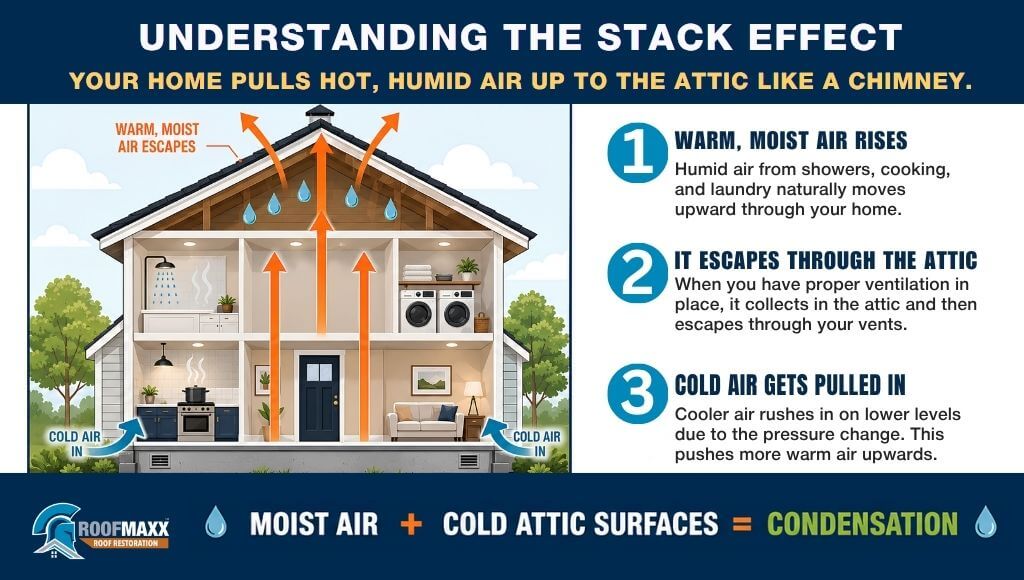
Attic humidity comes down to basic physics. Warm air holds more moisture than cold air, and it naturally rises through your house through the stack effect (see the infographic above for the science.) If it has nowhere to go, it settles in the highest open space in the home like a hot, heavy blanket.
In a healthy attic, fresh outdoor air dilutes that moisture and carries it away so both the temperature and the humidity level stay balanced.
Where you start to have problems is when you have:
Moisture condenses on any cold areas the moment the temperature drops below the dew point. The more problems you have at the same time, the more opportunity there is for that condensation to happen.
Don’t Miss: What To Do If Your Roof Vents Leak
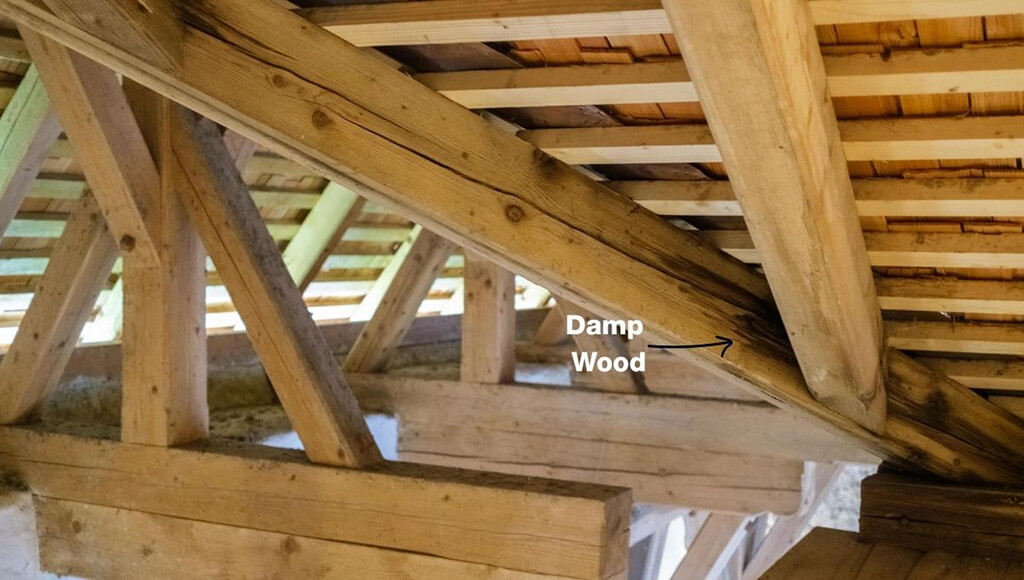
Your roof deck is the layer of plywood or OSB panels that your shingles are nailed into, and its main role is to carry the weight of the entire roofing system. Both materials are made from layers of wood bonded with a special adhesive that can break down if it stays damp.
Standing water will definitely make it worse, but the total moisture content level only needs to be around 20% for more than a few minutes to kick off the degradation process.
Once it begins:
None of this is visible from outside of your home or the roof itself, and it also happens in places most people don’t pay much attention to throughout the year. That’s why it’s so common for people to only discover it once they start experiencing other symptoms, like a strong smell of mold.
Learn More: The Cost of Repairing Your Roof
Your shingles are nailed directly into the roof deck, which means they’re only as secure as the wood gripping them. In dry plywood, each nail resists roughly 60 to 80 pounds of pull-out force. Once the wood gets wet, the strength drops by over a quarter, and rot takes it down even further.
But that’s just the beginning, because:
Poor ventilation, the number one cause, also contributes to thermal cycling, a process where the temperature of the attic is out of sync with the ambient temperature outside. Your shingles bake from the inside out all summer, then in the winter, hot air from your home turns into more condensation again.
All of this compounds together to wear away at the asphalt in the core and break it down. Eventually, the softening oils that keep it flexible are either forced out of the shingle or dry out. The shingle ages and degrades much faster than it should and is much more vulnerable to damage.
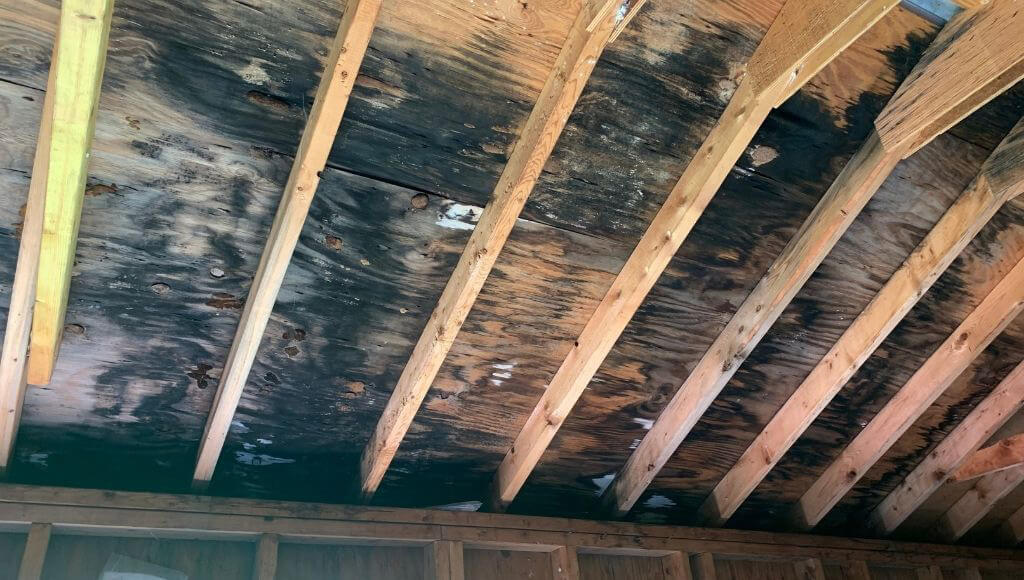
Mold spores are present in virtually every building on Earth in the form of particles that float around harmlessly until the conditions are right. Once the ambient temperature hits 40°F with a humidity level of around 60%, they wake up, start looking for a food source, and explode in numbers.
Unfortunately, most attics are effectively an all-you-can-eat spore buffet. Cladosporium and Aspergillus, two of the most common types here in the U.S., love to eat the wood and paper in your decking, and the dust, rafters, and framing are the perfect habitat for colonies.
This can have serious consequences for both your roof and your indoor air quality.
According to the CDC, common symptoms of mold exposure include:
Symptoms can be worse for children, older adults, and anyone who is already unwell or has a compromised immune system. If the mold itself spreads into your home, you’ll definitely smell it, but it can also colonize your walls, furniture, clothes, carpet, and even your windows.
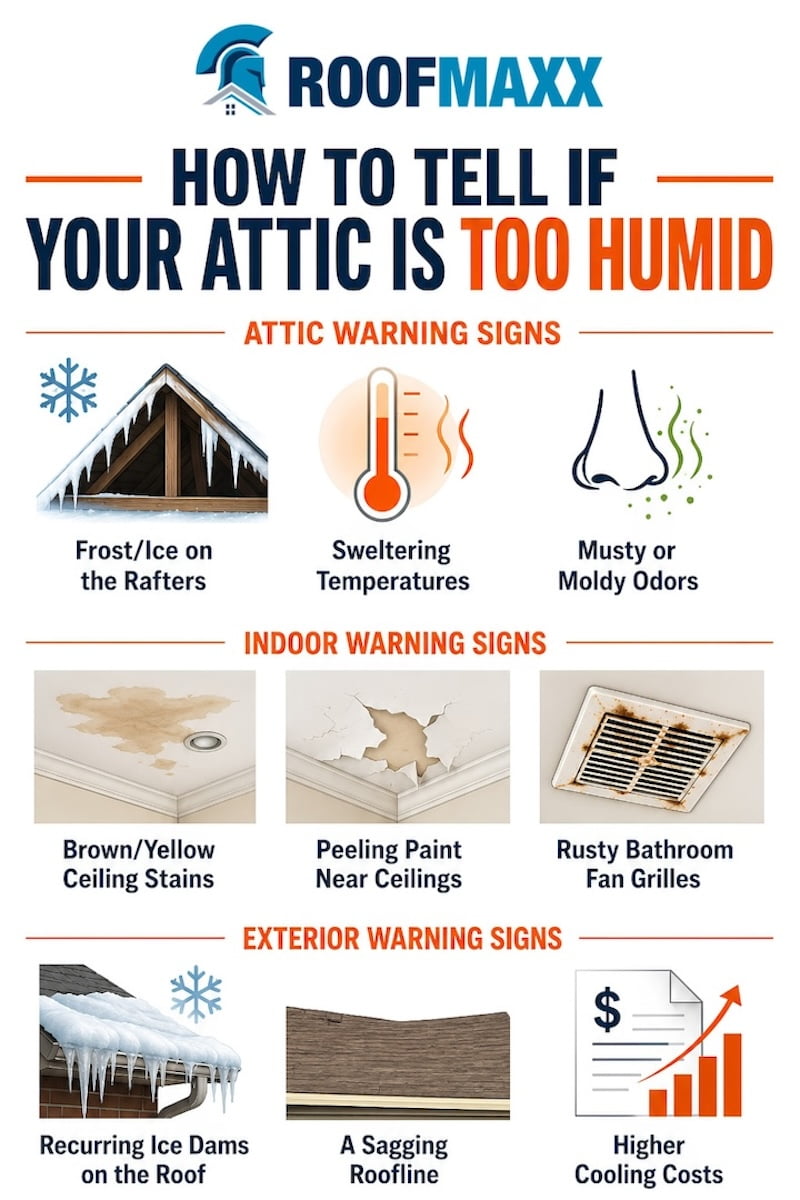
Upgrading the ventilation in your attic will set you back a few hundred dollars, but moisture-rotted decking is significantly more expensive to remediate if you don’t catch it early. That’s why every homeowner should check for the most common red flags on a regular basis and schedule yearly inspections.
The easiest DIY approach is to just climb up there and take a look every so often. You’ll usually feel the humidity like a wall of heat if it’s very high, but the difference will vary depending on the weather. Seeing frost or icicles on the rafters is also a red flag, as is a musty odour in the attic itself.
Other warning signs aren’t even in the attic:
All of these are signs that the moisture level in your home is too high. Call a pro for an inspection right away, and definitely consider installing a smart hygrometer or humidity sensor. Newer smart versions let you check in on the numbers from your phone at any time.
The same stack effect that pumps moisture into your attic can also flush it out. Cool, dry air enters through vents at the eaves, picks up moisture as it warms, and rises out through vents at the peak. This creates a constant loop of movement that prevents the humidity level from getting too high.
To achieve this, you’ll need the right mix of vents:
You want to ideally aim for around 1 square foot of vent space for every 150 square feet of floor, split evenly between intake and exhaust vents. GAF has an easy-to-use calculator that can help you nail down the perfect amount for your home if you’re looking for a more precise number.
Need advice on which vents to pick? Check out our free Roof Vent Guide.
There’s not much point in putting on a new roof or restoring your aging shingles if the attic itself is just going to rot them out again. New shingles nailed into compromised decking fail early, and while Roof Maxx is a great product, it can’t magically fix water-logged wood, mold, and other structural problems.
This is exactly why every Roof Maxx treatment process starts with a free roof assessment. Your local dealer will come out to the property and inspect your roof up close, then give you feedback about what they find and make recommendations about what should happen next.
Some dealers even offer a Roof Tune-Up to address minor problems like nail pops, cracked caulking, or a missing shingle or two before your treatment. See why it’s so critical for extending shingle life here.

The weather outside can really do a number on your roof over the years, but if you aren’t checking your attic often, it can also potentially distract you from what’s going on on the other side. A bad ventilation setup will drive the kind of temperature and humidity problems that cost you big later on.
At Roof Maxx, we believe in giving you all the information you need to approach roof care and roof problems like these with confidence. Find out what you can expect when you schedule an assessment with us, how we screen for issues like these, and more in our Roof Assessment Guide.
Aim to keep the humidity in your attic below 50%, although anywhere between 30% and 50% is even better. It’s not a big deal if it exceeds 60% briefly on a high-humidity day, but it shouldn’t stay that way for any real length of time.
You can expect to spend around $150 to $300 for a ridge vent and $200 to $250 for a soffit vent, not including installation. The bigger the space, the more vents you’ll need, but it’s still much cheaper than trying to fix water-logged wood.
A dehumidifier can lower the moisture for a while, but it’s really only a band-aid, so treat it like a temporary stop-gap measure only. Better ventilation is the only real way to permanently solve this problem for good.
Warm, moist air from your home rises and meets the cold underside of your roof deck. When that surface drops below the dew point, the moisture turns to frost or water droplets, then soaks into the wood.
Yes. The same air currents and pressure changes that move air through your ceiling can carry mold spores down into your living space, where they affect your indoor air quality and health. You should take action to resolve it right away if you suspect a problem.
Physically checking every few months is a great start, but you also want to make professional checks a part of your annual inspection if you can. Smart hygrometers and thermometers make this easier because you can just pull the app on your phone no matter where you are.



With our five-year, transferable warranty, you’ll enjoy the peace of mind that your roof and entire home are protected.