
Podcast Episodes / Building Scalable Roofing Teams Through Structured Training
Mike started climbing roofs after high school in 1985 and started his own roofing business by 1988.
He says Roof Maxx did not need highly skilled technicians, so it recruited business opportunity seekers as dealers.
Mike tells dealers they always have to be recruiting, and the best hires usually come through their own network.
He says most small businesses do a poor job at training, and training is the big thing after hiring.
Mike recalls training the first dealers over FaceTime and turning repeated answers into videos for Roof Maxx University.
He asks every manager candidate whether they are comfortable firing, and digs deep on the answer.
Mike says that past roughly 60 to 70 people, a company's culture starts to shift and needs active leadership.
Fletcher Wimbush 00:05
Welcome to People First Builders, celebrating leaders in construction who build success through their people. My name is Fletcher Wimbush, your host. I’m the CEO of Discovered, a performance hiring software helping small and midsize AEC companies solve their hardest problem: people.
Today I’m really excited to have Michael Feazel with us. He’s the co-founder and CEO of Roof Maxx. Michael, you’ve been in this business since 1988, or even before that.
Mike Feazel 01:09
A long time.
Fletcher Wimbush 01:10
A pioneering leader in the roofing and construction space. You’ve got some notoriety: a longtime writer, influencer and contributor to the space, helping others elevate their game through content, great ideas and being a great leader. At some point you exited the business and went on to create a unique product, Roof Maxx. Now, after running a roofing company and being on top of roofs for a long, long time, you’re on the other side, as a partner to the people doing that work. So I’d assume you have a lot of unique perspectives on the talent and people challenges of running a roofing business, right?
Mike Feazel 02:12
Yeah, definitely. Finding great talent is important in any industry, and every industry has its own challenges. I started in roofing back in the mid-80s. I got out of high school in ’85, started climbing roofs then, and by ’88 started my own business. The labor pool has changed a lot over the years. Blue collar was acceptable in the mid-80s, but through the 70s and 80s college became so important. It got to the point where a lot of kids getting out of high school weren’t even sure they could have a successful life without college.
We’ve seen that flip quite a bit in the last few years with AI. Now the question is, what am I going to do? White collar is very threatened right now, and blue collar is kind of becoming in vogue again. A lot of the top AI experts are asking, what do I tell my children? Tell them to become a plumber.
Fletcher Wimbush 03:20
Plumber, roofer, any trade. There’s extreme demand for that talent, and people get paid really well in many cases. I’ve got a buddy who’s an electrician in Northern California. That might be an extreme example, but they’re paying electricians around $200,000 a year. It can be a great lifestyle and a great living, and it’s something you can be proud of. Hopefully we’re seeing a reawakening that being in the trades can be a rewarding career in many ways, not just financially.
What are some of the biggest trends you’ve seen with your partners? What challenges are they facing, and have they found any creative ways of solving them?
Mike Feazel 04:19
Interestingly enough, when we sold our roof replacement company, which was a traditional roofing company, you needed skilled technicians who knew how to repair, find a leak and replace a roof. With Roof Maxx, what my brother and I saw when we came across the product was different. For the listeners: we’re simply applying a plant-based treatment that soaks down into the shingles. An asphalt shingle roof needs to be replaced when the oil dries out, for the same reason you get a pothole in the road. If the oil stayed in the asphalt, that road would last forever. But it dries out, and that’s why a roof fails. Our treatment soaks down into the shingle, replaces the lost petrochemical oil with a natural bio oil and brings that roof back to life.
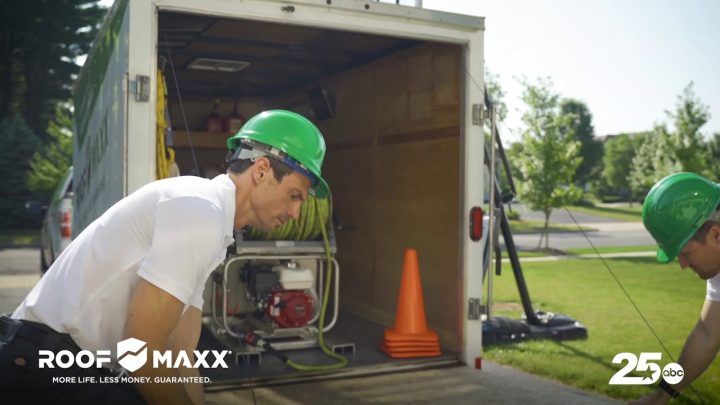
Because of the product, we realized very early on that we did not need extremely skilled technicians. So as we looked for business partners, we went a different path. It’s a dealer model, but for all intents and purposes it’s structured like a franchise: we give all the support and the training, they buy product from us, and they drive a vehicle wrapped in our design to keep the branding consistent. We went after business opportunity seekers. A lot of our partners are people like yourself: everything from ex-bankers, to people coming out of insurance, to construction people. We have plenty of women as well.
Fletcher Wimbush 06:05
So you’ve got people in a truck, maybe with a crew, marketing to homeowners, and in some cases commercial property owners.
Mike Feazel 06:18
Yep.
Fletcher Wimbush 06:19
Saying, “How do I get another 10 years out of this asphalt shingle roof?” That’s an alternative to re-roofing, and I imagine there’s some recurring revenue in it too, coming back every so often to get the most out of the roof. As a homeowner, that’s a lot more palatable than forking out 20 grand to re-roof.
Mike Feazel 06:49
Exactly. We kick the can down the road five years at a time. Each treatment lasts for five years. We come out and assess the roof again five years later and see whether we can get another five years. We’re helping 80% of customers avoid replacement. It’s a way to strengthen the roof and extend its life. A lot of customers aren’t even waiting until the end of the roof’s life. They’re doing it earlier in the life cycle just to keep the roof healthy and strong.
Fletcher Wimbush 07:16
Are you partnering with traditional roofing companies as well, as an add-on service? There can still be storm damage or leaks for other reasons, and you want a long-lasting relationship with the customer, not “I’m the guy who comes every 30 years.”
Mike Feazel 07:39
Yeah. We’re seeing more roofing contractors come on board. Roof rejuvenation was a new industry. We created that industry; it didn’t exist before. In the commercial roofing world there’s been roof restoration for 30 or 35 years, and it’s become more and more popular. Commercial properties very rarely put a roof on, let it fail and then replace it. There are inspections, maintenance, repair and restoration, GE silicone as an example. So we knew it would work on the steep-slope side. There’s never been a way to maintain an asphalt shingle roof other than blowing the debris off or trimming tree branches back. Our product is the first time there’s been a way to actually maintain a roof and extend its life. If we catch it early enough, we can double the life of the average roof out there.
Fletcher Wimbush 08:45
You still have to find people willing to go out on that truck and climb up on roofs in all kinds of weather. How are your dealer partners attracting people to come work and stick with this job? I imagine they have everything from salespeople to the crews on the roof, and it’s a forever challenge. What challenges have they faced, and what solutions are they bringing to the table for finding and retaining people?
Mike Feazel 09:21
I think the challenges differ by contractor: how they see the world, the size of their business, and different parts of the country. But by and large, I tell dealers, because I believe this, you always have to be recruiting. You always have to be looking for great talent. I don’t think that ever really stops.
Some of the old ways, like just posting ads online, can work to a degree. I tell people the best way is to go through your network, because you’re looking for people who will fit your culture. Even a small company has a culture, even if it’s a culture of three. The culture of a company is typically driven by the owner: how they see the world, how they want to treat their customers and how they want to treat their people. For a small business, I think that’s one of the better ways to do it.
As you grow, of course, you have to be more aggressive with recruiting and with what those skills look like. Are you going to have a 20-minute conversation and say, “You’re hired, see you Monday,” or do you have a multi-step process of recruiting and hiring? And then training is the big thing. Most small businesses don’t do a great job at training.
Fletcher Wimbush 10:40
I think you’re touching on something there with training. You covered job boards, which are the obvious place to go and necessary in many cases. You talked about referrals, tapping into your network, and that’s by far the number one. Something like 87% of hires made through referrals are considered good to great, which makes sense if you think it through.
And “always be recruiting,” like the old “always be closing,” is a mindset that can be challenging. I find it’s difficult for small business owners to build that habit and build a bench. I talk to so many leaders, and very few really pull it off.
Mike Feazel 11:36
You have to get to a certain size to do it. It helps when you have an HR person or department. That’s the Achilles heel of small businesses: they’re not good at recruiting. The proverbial one-man band wears so many hats, and that’s why they tend to hit a glass ceiling. Most small businesses never make it past three, four or five people.
Fletcher Wimbush 12:00
But you must have some dealer partners who have expanded into larger organizations and figured out how to scale and systemize.
Mike Feazel 12:13
They have. Those tend to be people who come from a background where they’re professional managers, whether of a sales team or a production team. They know how to build teams, and they’re a little more strategic in their approach.
Fletcher Wimbush 12:30
Coming back to the last piece: assume you’ve found somebody, however you found them. Once they show up on Monday and it’s time to go to work, training and onboarding is an often severely overlooked part of the hiring process. You might be paying them and they might be in your payroll system, but hiring doesn’t really end until they’re fully bought in and fully productive. What lessons or best practices have you learned there? You’ve been pretty integral in creating training and education programs for the industry, right?
Mike Feazel 13:36
For the industry itself, and also for our dealers. We have Roof Maxx University. We can onboard a couple hundred dealers a year and put them through all of the training. A lot of it is automated and a lot of it is hands-on. Every week there’s a three- or four-hour training for the newer dealers coming through. We also connect all the dealers in a closed Facebook group where they share ideas. A dealer, especially a new one, can be on a roof and have a question: does this roof qualify? They snap a picture, and in five minutes they have seven or eight responses.
Fletcher Wimbush 14:16
So the dealer network chimes in and helps the newbie out, instead of leaving them hanging on top of that roof.
Mike Feazel 14:23
Yeah. You look at different ways to be creative. We’ve built out learning management systems and all of that, and I don’t think it ever really ends. It’s an ongoing, evolving process.
Fletcher Wimbush 14:36
There must be significant intentionality there. I imagine in the early days it was a more primitive system. How has it evolved? When you got your first dealer partner, was it just, “Here’s your truck and some product, go fix some roofs”?
Mike Feazel 14:55
Our first dealers were trained on FaceTime, back in late 2018, early 2019. I started to realize I was answering the same question over and over again. When we hard-launched, we became one of the fastest-growing business opportunities in history. There was a ton of demand, and we didn’t have the systems in place. We weren’t prepared for that kind of growth. So once I’d answered a question for the third time, I would just make a video on it, send it to somebody on the team and say, “Put this in a folder and call it Roof Maxx University.” Then it became more formalized and more polished over time, and now it’s a learning management system. It’s evolved quite a bit.
Fletcher Wimbush 15:50
That’s probably going to be true for many smaller businesses that haven’t got there yet, and it’s a great real-life example. It isn’t going to be perfect. You’re probably going to be the one who answers the email or the phone when a new hire has a question. But once you’ve heard it a couple of times, be intentional: take two extra seconds to log it and document it, then hand it off to a virtual assistant, office manager or admin to build out the learning platform. I’m a big fan of Trainual for small businesses. There are lots of learning management systems out there, but on the small business side that tends to be an easy, low-cost solution. Be creative, like you said, be intentional, and then put in the work and do the reps.
Fletcher Wimbush 16:54
Here’s something that always shocked me about roofing. When I started working with my first couple of roofers, they told me their workers’ comp rate, especially in California, was something like 75 cents on the dollar. If you pay somebody a dollar, you have to pay another 75 cents just to insure them. Are you still seeing that in your sector? From a safety, training and workers’ comp perspective, what guidance are you giving your dealer partners, or what are you seeing them do to lower their experience mods so they can be more competitive?
Mike Feazel 17:42
It’s very different state to state. Ohio is much different from California. Roofing in California is through the roof, like everything there, because it’s so overregulated that it becomes very expensive. 75 cents on the dollar is an awful lot, when you can be at 18% on the dollar in other states that, in my opinion, manage things better.
Fletcher Wimbush 18:05
That’s still a lot compared to 3% for an office worker.
Mike Feazel 18:12
Correct. And unfortunately that cost gets carried back to the consumer as a very high price. You see it in certain states. Chicago is very heavily regulated. Florida is heavily regulated for roofing because of the hurricanes. The Midwest, not so much.
Different dealers handle it differently. I don’t get really involved. If somebody has a question, I’ll give them my opinion. But as a dealer model, we’re not going in and structuring packages to buy workers’ comp across the state of Ohio and getting 30 dealers together to get a lower rate. They have to go out and find those kinds of organizations, and they exist. I did that at Feazel Roofing, the roof replacement company I started in the mid-80s. So we encourage them to be creative and build a business, but we don’t hold their hand down to that level.
I’m always happy to have those conversations. I get those questions on our weekly call. There’ll be a few hundred dealers on the call, somebody will ask a question, and I give them my honest answer. Then I tell them to do the research and make the best decision they can. We coach them more on how to sell the product and how to market, rather than the detail of day-to-day business operations.
Fletcher Wimbush 19:35
Are you seeing many of them build successful sales teams and grow beyond the one-man show on the sales and marketing side?
Mike Feazel 19:44
Yeah. We have a handful of dealers who will probably break into the $10 million range this year. They’ve built successful companies.
Fletcher Wimbush 19:51
Anything you’ve seen them do to be really successful at building that out? I’d assume a lot of it is direct sales, or are they doing more marketing?
Mike Feazel 20:01
A bit of everything. But they just know how to build a team. They know how to operate. They’re operators, and they know how to execute. Like in any business, most small businesses don’t make it past five people, and there’s a reason for that. It doesn’t mean the owner is bad. They just don’t know how to execute, or they do know how and they’ve found the work-life balance they’re looking for.
I’ve got a lot of friends in the construction business, and most of them bumped their heads once they got past two, three or four people. They don’t want to deal with the headaches of employees. They don’t like to fire. In my early years I wasn’t comfortable firing. Today it doesn’t bother me at all to fire somebody who’s not doing their job. I don’t lose any sleep. I used to lose a lot of sleep over that. It doesn’t make me bad. It just makes me realize that if I don’t do it, the company is in jeopardy.
Fletcher Wimbush 20:50
You’re kicking a problem down the road for everybody involved, including the person you’re going to let go, because once you’ve emotionally made up your mind that the person needs to leave…
Mike Feazel 21:01
It’s a problem, right? One of the first questions I ask anybody I’m hiring as a manager is, are you comfortable firing? Then I go deep down that rabbit hole with them, because I want to understand where they are in their managerial career. If you’re really uncomfortable firing, you haven’t fired enough people. And if you haven’t fired enough people, either you haven’t worked for great companies or you haven’t been a manager for very long, because great companies don’t keep weak people around. They have KPIs to drive the right outcomes. Most great companies wouldn’t even let you be in a management position unless you’re comfortable letting people go.
So it comes down to the maturity of the business owners and where their skill set is. And maturity is not age. Maturity is experience and how you see the world. Our great operators are just great business people. The ones who stay one-man bands either have no desire to get bigger, because they make enough money and like the quality of life, and it’s not for me to say, I’m fine with that, or they just don’t have the skill of recruiting, bringing people on, getting them excited and selling a vision.
Fletcher Wimbush 22:15
You mentioned the KPI side. When I ran a blue-collar shop, commercial dish machines for a period of time, I was blessed to be part of a really great organization with a lot of education behind it. We measured everything, and it made things really simple to manage. Literally every day we talked about people’s KPIs, and that made it a lot easier when we had to let people go. We had the backing of a large organization, but people would also just self-select out. Pretty early on they’d realize they weren’t meeting the numbers and it wasn’t a great fit, so you almost didn’t have to have the conversation. They’d leave on their own. But if you’re not always recruiting, that becomes painful for you as a leader, because now you have a big gap, and it can take time to backfill a role.
Mike Feazel 23:14
And in today’s virtual world… It was brought to my attention that somebody from our team who had been let go did an interview with another company, and during that interview he openly admitted that he was only putting in 15 to 20 hours a week, because he was getting all his work done with AI.
As a virtual company, I’m hyper-aware of that. When I message one of our people on Slack and there’s always a five- or eight-minute delay, I’ll pull up their calendar to see if they’re busy, make a mental note, or let a manager know that this person doesn’t seem to be around all the time. I’m one to just message somebody directly, not send “let me know when you’re available.” The work environment has changed so much. It’s not that you don’t trust people, but I’m a big believer in trust and verify.
Fletcher Wimbush 24:22
That’s where metrics really come into play. And look, if somebody is able to do their work in 20 hours a week, then pay them more to do another 20 hours. If I can increase your pay 30% and you double your output, the return on that person is amazing. I’d go for that. But what you’re describing on the communication side is ultimately a culture thing: is this a culture where we’re responsive, to internal partners and to customers? People who are slow to respond to you may also be slow to respond to a customer.
Mike Feazel 25:11
We’ve got a great team. This was just one instance. But there are struggles with being virtual. We are a virtual company, dispersed across the country, with coders in Europe and Brazil, and of course dealerships across all 50 states. We don’t have bricks and mortar other than our manufacturing facility, so there have been challenges with that.
Once you get past 60 or 70 people in a company, you stop knowing everybody’s name. There are layers of management in between. That’s not a big company, but past about 70 people it’s hard to remember names, or you’re just not interacting with people that much, and the culture starts to shift. I experienced that at my roofing company and I’ve experienced it with this company. But people are amazing. A business is nothing but a group of people with a common goal, working to achieve it, and you try to provide leadership and motivation to get there. In theory, it’s very simple.
Fletcher Wimbush 26:20
In practice, easier said than done. People are the least exact science. It’s easier to go to Mars than to predict anything about a human.
Mike Feazel 26:36
Business is messy because we’re messy as humans. Building a system that keeps everybody rowing in the same direction, with the motivation and the excitement, is challenging, but it can definitely be done. People are wonderful. They’re amazing.
Fletcher Wimbush 26:52
Look at what you’ve been able to do in multiple arenas. And there are different ways to get there as well.
Mike Feazel 26:59
Very much. My old business was bricks and mortar. Everybody came to the office, all the employees and the installers, and there were a lot of water-cooler conversations. A lot was learned there, and relationships were built that, quite frankly, you don’t build in a virtual environment unless you’re in consistent meetings with that person and they’re part of your team. Many people you just don’t know unless you see them at the conference.
Fletcher Wimbush 27:23
Awesome, Mike. I really appreciate you sharing your perspectives. How can people get hold of you?
Mike Feazel 27:30
Just go to roofmaxx.com. We’re easy to reach.
Fletcher Wimbush 27:40
We’ll make sure any contact information you want shared is in the show notes. I really appreciate having you on today, Mike.
Mike Feazel 27:53
Thanks for having me on. I appreciate it, Fletcher. Good luck.